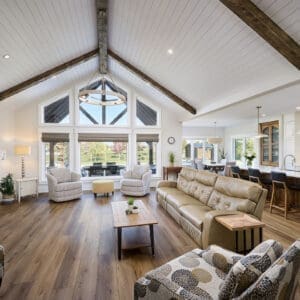
In custom home design, one of the most defining shifts in recent years has been the intentional blending of indoor and outdoor living spaces. Nowhere is this more relevant than in Niagara, where seasonal variation is significant, but the desire to enjoy the outdoors remains constant throughout the year.
Homeowners are no longer thinking of outdoor spaces as separate or secondary. Instead, they are increasingly being designed as integrated extensions of the home’s primary living areas. This evolution is driven by lifestyle changes, architectural innovation, and a growing appreciation for natural light, ventilation, and connection to the landscape.
Architectural openness as a design principle
At the centre of this trend is the use of expansive architectural openings. Large sliding glass systems, retractable walls, and multi-panel doors have become essential tools in achieving seamless transitions between interior and exterior environments. These systems allow entire walls to disappear, effectively transforming a living room into a covered outdoor lounge or an indoor kitchen into an open-air entertaining space.
But the success of these features is not just in their scale—it is in their integration. When properly designed, these openings align with ceiling lines, flooring transitions, and structural elements to maintain visual continuity. The result is a space that feels cohesive whether it is fully enclosed or completely open.
Material continuity and visual flow
Another important consideration is the use of consistent materials across both environments. Interior flooring that extends outward to covered patios, natural stone finishes that appear both inside and outside, and complementary wood or composite accents all contribute to a unified aesthetic.
This continuity helps reduce the psychological separation between inside and outside, encouraging more frequent use of exterior spaces. Even subtle decisions—such as matching ceiling treatments or echoing exterior lighting styles indoors—can significantly enhance the sense of flow.
Designing for comfort across seasons
In Niagara, where winters can be harsh and summers warm and humid, performance is just as important as aesthetics. Covered outdoor rooms, integrated heating elements, ceiling fans, and strategically placed wind barriers all help extend usability beyond the summer months.
Similarly, shading systems such as pergolas with adjustable louvers or automated screens allow homeowners to adapt their outdoor environments in response to changing weather conditions. This flexibility is key to ensuring that these spaces are not just visually appealing, but genuinely functional throughout the year.
A lifestyle-driven approach
Ultimately, the goal of blurring indoor and outdoor boundaries is not simply architectural—it is lifestyle-driven. These spaces support how people actually live: entertaining guests, spending time with family, enjoying quiet mornings with coffee, or transitioning effortlessly between cooking, dining, and relaxing.
In custom homes, this approach represents a shift away from isolated rooms and toward interconnected living environments. The house becomes less of a structure and more of a continuous experience—one that engages directly with its surroundings.